
Ceramic, porcelain or natural stone: which floor tile suits your home?
When choosing floor tiles, people often look first at colour, size and appearance.
But a tile that looks beautiful in a showroom is not automatically the best choice for a hallway, kitchen, bathroom or living room.
At MULTI Klussenbedrijf, we therefore look at the complete picture:
use of the room → wear resistance → slip resistance → maintenance → substrate → underfloor heating → finish.
Ceramic tiles
Glazed ceramic is available in many colours, patterns and price ranges.
For rooms that are not subjected to extreme loads, it can be an excellent solution.
The top glaze layer largely determines the appearance and wear resistance.
That is why, for a heavily used hallway or kitchen, it is wise to look not only at the design but also at the usage class of the tile.
Porcelain / gres porcellanato
Porcelain tiles are fired more densely and absorb very little moisture.
As a result, they are wear-resistant, easy to maintain and not very susceptible to stains.
For a Dutch hallway, kitchen or living space, porcelain is therefore often a safe and practical choice.
Wood-look and concrete-look tiles are also often made in porcelain nowadays.
For example, the appearance of wood can be combined with the low-maintenance qualities of tiling.
Natural stone
Natural stone has an appearance that ceramic can never fully replicate.
Each tile can differ subtly in colour, structure and veining.
On the other hand, materials such as travertine and marble require more maintenance.
Porous natural stone must be properly protected against moisture, oil, wine and other liquids that can soak into the surface.
Anyone choosing natural stone is therefore choosing not only for the look but also for the associated maintenance.
Which tile for the hallway?
The entrance is exposed to:
sand, wet shoes, dirt and relatively heavy foot traffic.
That is why a hard, wear-resistant and not too slippery tile is more important here than, for example, in a bedroom.
Matt porcelain is usually more practical in a hallway than a very slippery high-gloss tile.
The grout colour also deserves attention.
A very light grout in a heavily used entrance clearly requires more maintenance than a calm grey shade.
Which tile for the kitchen?
In the kitchen, not only water but also oil, coffee, wine and food end up on the floor.
That is why a dense surface is preferable.
A tile with a very deep texture can look wonderful, but grease and dirt cling to it more easily.
For a kitchen, we therefore look for a good balance between:
slip resistance, ease of maintenance and appearance.
Bathroom: slip resistance comes before appearance
A bathroom floor can become wet.
That is why a suitable slip rating is important.
For a normal bathroom floor, a minimum of R10 is often chosen, while for wetter zones a rougher surface such as R11 may be more appropriate.
In a walk-in shower, the size also plays a role.
Smaller tiles or mosaic can more easily follow the required fall towards the shower drain or floor drain.
With very large tiles, much more preparation and cutting work is required.
PEI class: how wear-resistant is the tile?
For glazed tiles, the PEI classification gives an indication of wear resistance.
For a quiet living space, a lower class may be sufficient.
For corridors, kitchens and entrances, a higher usage class is usually chosen.
It is therefore wise not only to ask:
"Which colour do we want?"
but also:
"How intensively will this floor be used daily?"
Rectified tiles and narrow grout joints
Do you want a modern floor look with narrow grout joints?
Then rectified tiles are interesting.
These are precisely ground to size after production, allowing tighter joint widths.
But the narrower the joint, the more important a flat substrate becomes.
With a large-format tile, a small height difference between two tiles is immediately visible.
Large tiles require a level floor
A 60 × 60 cm tile is more forgiving than, for example, a size of 90 × 90, 120 × 60 or larger.
With large tiles, an unevenness in the substrate becomes visible more quickly as a raised tile edge.
That is why, before tiling, we check whether levelling or local smoothing is required.
Laying an expensive tile on a poor substrate does not produce a high-quality end result.
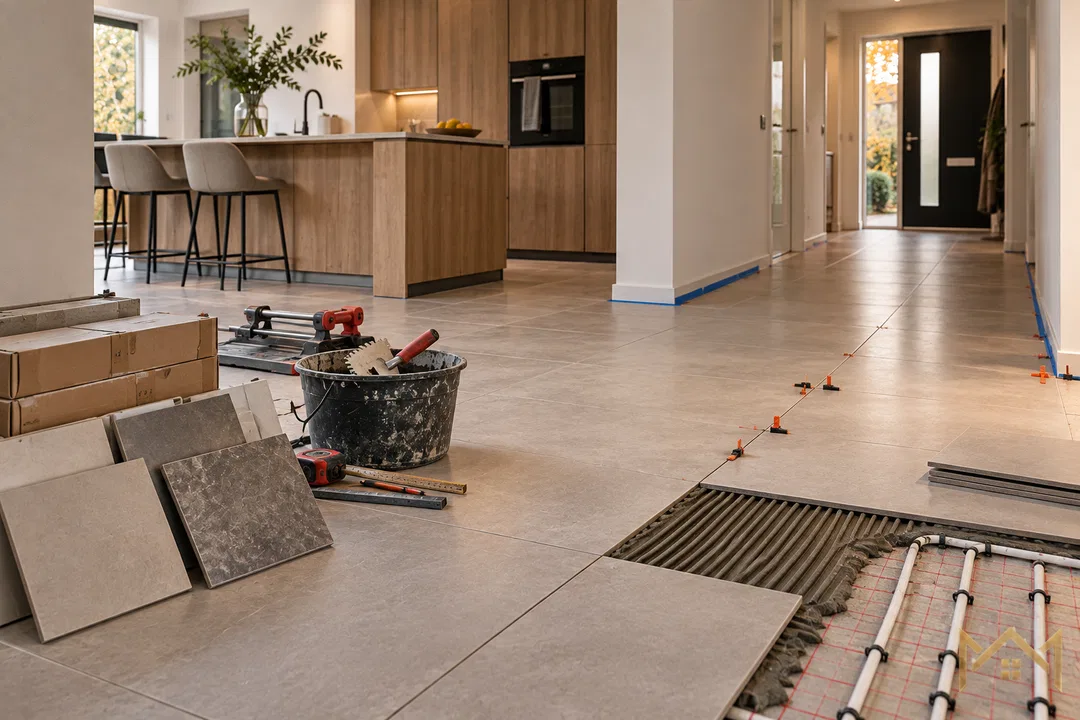
Floor tiles and underfloor heating
Ceramic and porcelain work excellently with underfloor heating.
The materials conduct heat well and offer relatively little resistance between the heating system and the living space.
But the tile itself is only one component.
The following points must also be right:
- screed sufficiently cured;
- suitable adhesive system;
- correct edge and movement joints;
- underfloor heating switched off during tiling;
- controlled heating-up after sufficient curing.
Heating up too quickly can cause unnecessary stress in the adhesive, grout and tiled floor.
Movement joints are not a mistake
A large tiled floor does not always consist of one completely closed surface.
Especially with underfloor heating, the floor must be able to move.
That is why flexible perimeter joints and, in certain places, movement joints may be necessary.
These joints are a technical part of a good tiled floor and should not simply be filled with hard grout.
Check the total floor height in advance
In a renovation, it is not only the thickness of the tile that matters.
Adhesive, any levelling compound and other layers also raise the floor.
This can affect:
internal doors, thresholds, kitchen plinths, existing frames and transitions to other rooms.
That is why we preferably determine the total floor build-up before tiling begins.
How many extra tiles should you order?
Ordering exactly the number of square metres is usually too little.
Material is needed for cutting, breakage and selection.
As a general guideline, approximately 10% extra material is often allowed.
For diagonal patterns, herringbone or rooms with many corners, approximately 15% extra may be wiser.
After completion, it is also advisable to keep at least one unopened box.
If a tile is damaged years later, tiles from the same series but a new production batch may have a slightly different shade.
The cheapest tile is not always the cheapest floor
A cheap tile with significant dimensional deviations or warping can require much extra installation time.
A dimensionally accurate, high-quality tile can actually be laid faster and more precisely.
That is why, when choosing materials, we do not look solely at the price per square metre.
The final result is determined by:
tile + substrate + preparation + laying work + grouting + sealing work.
📧 E-mail: info@multiklussenbedrijf.nl
💬 WhatsApp: Stuur ons een bericht
📝 Offerte: Vraag direct een offerte aan
Please log in to add a comment.
LoginNo comments yet. Be the first to comment!