Renewing grout and caulk seals: a small intervention that can prevent much larger moisture damage
Tiles can last for decades, but the grout and caulk seals between them wear out much faster.
Especially in a daily-use shower, these joints are exposed to water, soap, cleaning products, temperature fluctuations, and movement between different materials.
Black caulk, crumbling grout, or a separating seam therefore doesn't necessarily mean the entire bathroom needs to be replaced.
But simply applying a new layer over the existing material is usually not a sustainable solution either.
At MULTI Klussenbedrijf, we first look at the cause and the condition of the substrate.
When does caulk really need replacing?
You can often clean minor surface contamination.
But if black discoloration returns shortly after cleaning, the damage may be deeper in the caulk.
Other warning signs include:
- caulk separating from tile or shower tray;
- cracks in inside corners;
- hard, dried-out caulk;
- gaps around shower glass;
- moisture visible under or behind the seam.
In a wet room, moving joints should have elastic sanitary caulk and not hard cement grout.
This applies, for example, to wall corners, the transition between wall and floor, shower tray, bathtub, and other joints that can move slightly during use.
When should grout be renewed?
Cement grout wears differently.
Watch for:
powdering grout, worn grout, small holes, or sections that are clearly lower than the tile surface.
This can become visible faster, especially on a shower floor and around a drain.
When grout loses its integrity, a thin new layer on top makes little sense.
The damaged grout must first be sufficiently routed out so the new grout material can actually bond. The blog uses approximately 2–3 mm depth as a practical guideline.
First check if the problem isn't behind the tiles
This is an important distinction.
Do you only have old grout and caulk, while the tiles are secure and there are no moisture problems?
Then renewing the grout and caulk work can be a good maintenance solution.
But when:
- tiles sound hollow;
- a tile moves;
- there's a damp spot on the other side of the shower wall;
- there's a persistent musty smell;
- or caulk turns black very quickly again,
then it should first be investigated whether there's more going on.
New caulk over a waterproofing problem only makes the bathroom temporarily look better.
Good ventilation partly determines how long new caulk stays looking good
Bathrooms produce a lot of moisture daily.
When mechanical ventilation doesn't extract enough or a room stays damp for hours after showering, shower corners and cold surfaces are especially stressed long-term.
That's why when we see recurring black caulk, we check not only the silicone itself but also whether the bathroom can dry sufficiently.
Applying new caulk without addressing the cause of prolonged condensation can mean the same problem occurs again.
Remove old caulk completely
New silicone bonds poorly to old silicone residue.
That's why old caulk isn't just cut away at the surface.
The seam must be carefully emptied, residue removed, and the substrate must be clean, grease-free, and dry before new material is applied.
This is one reason why professionally applied caulk seams are often tighter and more durable than quick cosmetic repairs.
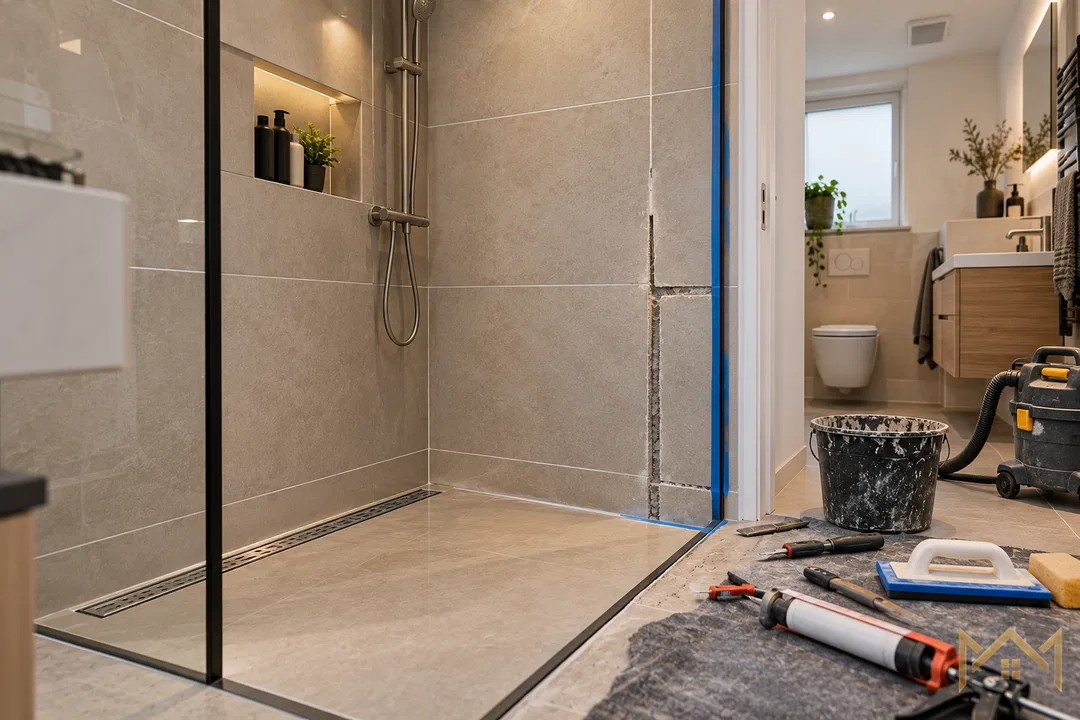
Routing out grout requires care
When removing old grout, work carefully along tile edges.
Routing too deep or incorrectly can damage a tile.
Additionally, cement grout produces a lot of fine dust.
That's why dust extraction and sealing off the work area are important, especially when the bathroom is part of an occupied home.
Grout first, then caulk
Work sequence also matters.
New cement grout must cure sufficiently before elastic caulk seams are applied.
In shower corners, a neat, flexible sanitary caulk connection is then made.
The shower shouldn't be used immediately afterward.
For new sanitary caulk, the blog typically mentions 24–48 hours waiting time before the shower is used again.
That drying time is part of the work, not just advice afterward.
Do only part or the whole bathroom?
Not every bathroom needs complete re-grouting.
Sometimes only the shower corners and connections around the tub or sink are worn.
In other bathrooms, the entire shower zone or all wall and floor grout work needs replacing.
That's why we first assess:
which zones are actually worn → what grout type is present → how the tiles are attached → whether there are moisture problems → how well ventilation functions.
This prevents good grout from being unnecessarily removed while problematic areas remain.
What does grout and caulk work cost?
According to the article, completely re-grouting and caulking an average bathroom in 2026 is indicatively around €700–€1,800.
For caulk work only or one shower zone, the amount can of course be lower.
The actual price depends on factors such as meters of caulk, amount of grout work, tile size, accessibility, and how much old material needs removing.
Most of the cost is usually not in the caulk or grout mortar itself, but in carefully removing, cleaning, preparing, and refinishing.
How long does it take?
According to the blog, completely re-grouting and caulking a bathroom typically takes about 1–3 working days, followed by the necessary curing time before the shower can be used again.
For loose caulk seams or a small shower corner, the work can of course be completed faster.
Combine grout work with other bathroom repairs
When maintenance is being done anyway, it's wise to immediately check other vulnerable connections.
For example:
- loose or damaged tiles;
- shower glass and profiles;
- drain around the shower floor;
- old caulk around sink or tub;
- ventilation;
- minor wall or ceiling damage.
This way, several small problems can be solved in one maintenance round.
Unsure if re-grouting is enough?
Send clear photos via AtaList of:
the complete shower, the corners, the floor, the drain, damaged grout, and discolored caulk seams.
Do you have a damp spot or loose tile somewhere?
Show that too.
This way we can first assess whether it's likely just grout and caulk maintenance or if further investigation is advisable.
When in doubt, we prefer to inspect the situation on site first before applying new material over an existing moisture problem.
📧 Email: info@multiklussenbedrijf.nl
💬 WhatsApp: Send us a message
📝 Quote: Request a quote directly
Please log in to add a comment.
LoginNo comments yet. Be the first to comment!