
Painting a ceiling: roll it yourself or have it done?
Painting a ceiling seems like a simple job at first glance.
With a flat ceiling at normal height, it can be.
But as soon as there are cracks, water stains, nicotine, loose plasterwork, ornaments or a high ceiling present, preparation especially determines whether the result stays neat.
At MULTI Klussenbedrijf, we therefore don't just look at the new coat of paint, but first at:
substrate → repairs → stains → height → protection → primer → final finish.
When can you paint a ceiling yourself?
A flat and sturdy ceiling up to about 2.60 meters high is usually manageable for a handy DIYer.
For a room with approximately 20 m² of ceiling area, the article mentions about 1 to 1.5 days of work, including masking and two coats of latex.
Rolling it yourself costs approximately €3–€7 per m² in materials.
That is especially interesting when:
- the ceiling is already flat;
- there is no moisture or nicotine buildup;
- there are no major cracks;
- and you can spare the room for a day or two.
First solve the cause of water stains
Simply painting a brown water ring white usually doesn't work.
If the leak is still active, it must be fixed first.
Even when the source has already been resolved, the discoloration can bleed through the latex again without a special primer.
That's why old moisture, nicotine or soot stains require an isolating primer first.
Only then are the final coats of ceiling paint applied.
Cracks and loose plasterwork
Small hairline cracks can usually be filled and sanded locally.
But when a crack returns, runs along a drywall seam or the plasterwork is loose, the substrate must first be repaired.
With new plasterwork, sufficient drying time must also be allowed.
According to the article, fresh plasterwork usually needs about 1–2 weeks before painting is advisable, depending on layer thickness, temperature and ventilation.
Why two coats of latex?
One coat sometimes seems sufficient when you're painting white over white.
Yet one coat often produces an uneven or cloudy result.
Repairs and old paint layers can absorb differently.
That's why two coats of latex are standard in practice.
The first coat makes coverage more uniform, the second provides the final even result.
How long does latex take to dry?
At approximately 18–20 °C and normal ventilation, ceiling latex is usually recoatable after about 4–6 hours.
This means two coats can sometimes be applied on the same day.
In a cold or damp room, this takes significantly longer.
At approximately 12 °C, the second coat is better postponed until the next morning.
Repainting too soon can cause streaks, poor adhesion or damage to the first coat.
Rolling or spraying?
Spraying latex can give a neat and quick result, especially when the room is empty.
In an occupied room, almost everything must be completely masked due to the fine spray mist.
Masking alone can take about 2–4 hours per room according to the article.
That's why rolling is often more practical in a furnished home.
Spraying becomes more interesting when multiple empty rooms or ceilings are finished at the same time.
High ceilings require a different approach
From about 3 meters high, working from a regular ladder becomes unsafe and impractical.
Then a rolling scaffold or special attic ladder scaffold may be needed.
In older city apartments, for example in Amsterdam, ceiling heights of 3.20–3.60 meters are common.
There, not only does the painting technique become more important, but also safe access to the ceiling.
Preparation determines the final result
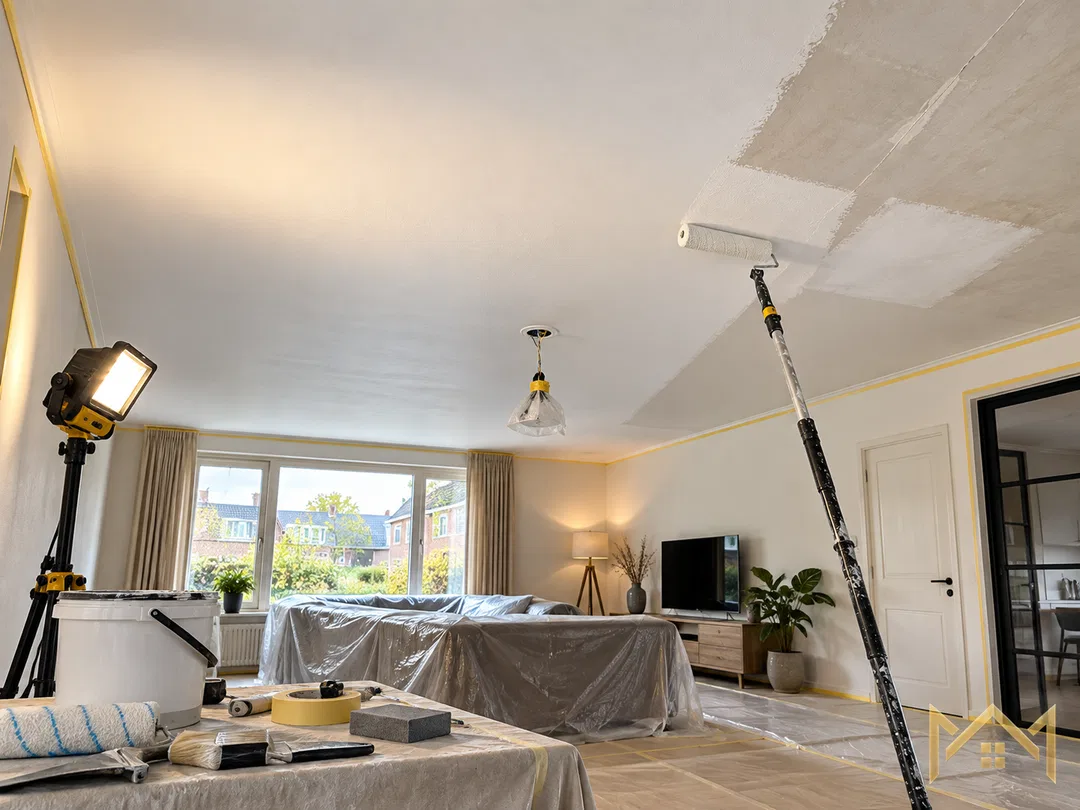
Professional ceiling painting usually starts with:
protect room → remove lighting → clean → sand → repair → primer/undercoat → first coat → dry → second coat.
For a ceiling of about 20 m², cleaning, sanding, filling and masking alone can take several hours.
It's precisely this preparation that you won't see after completion, but it determines whether the ceiling stays even.
What does ceiling painting cost in 2026?
The article mentions as an indication:
- rolling yourself: €3–€7/m² in materials;
- rolling yourself with isolating primer: €6–€11/m²;
- professional rolling including paint: €12–€22/m²;
- latex spraying: €10–€20/m²;
- plasterwork repair + painting: €25–€45/m².
For a ceiling of about 20 m², that means for example approximately €240–€440 for professional rolling including normal preparation.
Combine painting with other renovation work
If there is:
- new plasterwork being done;
- electrical work being adjusted;
- lighting being replaced;
- or a complete room being renovated?
Then it makes sense to include the ceiling right away.
Electrical work and any plasterwork repairs are done first.
Then painting follows and only at the end are fixtures permanently reinstalled.
This way, a freshly painted ceiling doesn't need to be reopened or touched up later.
Have a ceiling painted?
Send photos via AtaList of:
- the entire ceiling;
- any cracks;
- moisture or discolored spots;
- decorative moldings or ornaments;
- and the room itself.
Also mention approximately the dimensions and ceiling height.
Then we can better assess whether only painting is needed or whether repair, primer or plastering work must be included first.
📧 Email: info@multiklussenbedrijf.nl
💬 WhatsApp: Send us a message
📝 Quote: Request a quote directly
Please log in to add a comment.
LoginNo comments yet. Be the first to comment!